


Sanghamitra
Writer and Editor with 8+ years of experience in digital media. I write on policy, science, history, society and politics


In February 2026, De Beers Group, the company that was for nearly a century the global diamond monopoly, reported an underlying EBITDA loss of over $511 million for the financial year 2025. The numbers were staggering, and the newspaper reports that told the story had a single word that was a nod to the reason for this massive loss.
In previous decades, the De Beers Group was associated with ‘Diamonds’, just diamonds. In 2026, the global narrative has shifted. The $511 million loss was reported with the phrase ‘natural diamonds’. There lies the crux of the story.
Two years ago, Anglo American, the mining giant that owns the De Beers Group, had already smelled the incoming fall. In order to escape a hostile takeover bid by its main rival, the BHP Group, Anglo American CEO Duncan Wanblad had announced a radical restructuring plan in May 2024. Anglo American’s strategy was to divest from steelmaking coal, and nickel, spinning off non-core assets, and clear its decks by selling off the De Beers Group.
The diamonds, or rather ‘natural’ diamonds, have lost their lustre.
The $511 million loss reported by De Beers Group confirmed Duncan Wanblad’s deepest corporate anxieties. Update to August 2026: Anglo American’s desperate attempt to sell off De Beers has reportedly reached a rather sad, bruising chapter. De Beers, once reigning king of the diamond empire, is no longer a premium asset. Anglo American is reportedly circling around advanced negotiations to sell its 85% stake (the other 15% is owned by the government of Botswana) in De Beers for a humbling $1 billion.
In 2001, when Anglo American and the Oppenheimer family had made the company private, it was valued at $17.6 billion. In 2011, when Anglo American bought out the 40% share of the Oppenheimer family, the value was $12.75 billion. In 2023, the book value was reported at $9.2 billion. In early 2026, the diamond market realities forced Anglo American to write the value of De Beers down to $2.3 billion.

De Beers is struggling hard to stay relevant. They have scrambled to cut losses by cutting prices in their smaller, consumer-grade diamonds; they have also shut down their Venetia mine in South Africa for 2 years to cut production and artificially induce a supply choke; layoffs are being mulled, but prices just keep falling.
The reason? Diamonds are now grown in labs. Science makes in a week what geological forces took a billion years to create. Market realities say people no longer care much for the story De Beers fed the world for decades.
The entire modern industry of ‘natural’ diamonds was built on an illusion. For almost a century, the diamond cartel kept telling consumers that diamonds are a rare gift of Mother Earth, an eternal symbol of love and commitment, to be worn with pride, and they are worth whatever price the market asks. That story was probably the most successful lie ever sold in the history of marketing. The demand, the romantic folklore, the selling pitch, was all carefully engineered to sell the stones whose inherent value was always questionable.
Cecil Rhodes had arrived in the Kimberley diamond fields in South Africa in 1871 as a teenager. In two decades, he bought nearly every rival mine in the region, and in 1888 he formally established De Beers Consolidated Mines. He then went on another aggressive expansion spree, backed by the money of the Rothschilds. By 1890, De Beers controlled roughly 90% of the world’s diamond production. It was a monopoly so complete that by the time Rhodes died in 1902, De Beers set the terms for nearly everything in the global diamond industry.
The genius in the strategy did not lie in mining; it was in the supply chokehold. In the 1890s, De Beers struck a deal with the London Diamond Syndicate: they would buy a fixed quantity of diamonds at a fixed price, a price that De Beers negotiated. The company regulated output to protect value. In the coming decades, De Beers perfected this supply chokehold into an art form.
Whenever the market slumped, De Beers did not sell more to generate revenue; they sold less, to keep prices high. Ernest Oppenheimer, who had taken the reins of De Beers in later years after founding Anglo American, weaponised the same strategy through the ‘Diamond Trading Company’ and the ‘ Central Selling Organisation’. It was a system of mine ownership, exclusive contract with producers, and centralised selling.
Diamonds were abundant. De Beers locked them in their vaults, and choked the supply. The scarcity that made them ‘rare’ was manufactured in boardrooms.

The Great Depression brought poverty. Diamonds were not selling much. Amid the gloom, De Beers hired NW Ayer and Son, a marketing agency, to boost their sales. What followed was a masterclass case study in behavioural engineering, the most successful marketing campaign of the 20th century.
They made Hollywood movies feature diamonds as a mandatory ritual of courtship; movie stars were photographed wearing De Beers diamonds. Lecturers were sent to American high schools to tell teenage girls how diamonds are a necessity to officialise romance. In 1947, a copywriter at NW Ayer & Son wrote four lines that sealed the game for decades, making shiny carbon crystals a psychological necessity for engagement and romance worldwide: “Diamonds are forever.”
It was probably the most effective punchline ever written. The ‘forever’ sold the dreams of permanence for young couples: that their love will last forever if the engagement is sealed with a diamond ring. It quietly discouraged resale, because ‘forever’ means you don’t sell it; you keep it for the sake of an immortal love, you pass it down as a family heirloom. A resale market anyway is not good for a company that is staking its value on manufactured scarcity.
The result was that in the USA, Japan and even Europe, the diamond engagement ring became a strict cultural mandate. There were no such rules earlier about what an engagement ring should be, or even whether there should be one at all. But De Beers invented a tradition from thin air, with a marketing campaign.
The material reality of diamonds is a bit cold. They do shine bright. But unlike gold or silver, they never had a simple, universal purity standard that customers could independently verify. The value rested on the 4 Cs: cut, carat, colour and clarity, but that grading itself is a proprietary, subjective classification administered by an ecosystem built by the very industry that sells it, priced by a market the same industry controls.
Most of the metrics that decide the high price of ‘natural’ diamonds are, ironically, artificial.
Natural diamonds always carried a moral weight. In the 1990s, blood and conflict diamonds funded brutal civil wars in Angola, Sierra Leone and the Democratic Republic of Congo. Armed rebel groups controlled deposits and traded diamonds for weapons to carry out mass murders. Child labour in the mining and child soldiers carrying the weapons are a part of their grim hallmark. In just Sierra Leone, the Revolutionary United Front was reported to have generated around $100 million a year by selling blood diamonds before the war ended in 2002. The practice was mainstream enough for Hollywood and global pop culture to make high-profile titles like ‘Blood Diamond’ and ‘Diamonds from Sierra Leone’.
Facing global condemnation and a rising awareness of the blood stains on their stones, the cartel adopted the Kimberley Process Certification Scheme in 2003, brought by global governments and UN, to keep conflict diamonds out of the legitimate market. However, human rights groups have flagged flaws in it. The Kimberley Process filters diamonds based on whether they were funded or sold by ‘rebel’ groups. It does little to check state-sponsored violence, child labour and exploitation.
Community displacement and insulting, microscopic returns to African locals where the diamonds are mined are the other reasons the ‘natural’ stones are slowly losing their appeal. A more aware, socially conscious generation does not want moral and ethical stains on their sparkle.
The result was that blood diamonds did truly not disappear; they just became harder to trace.
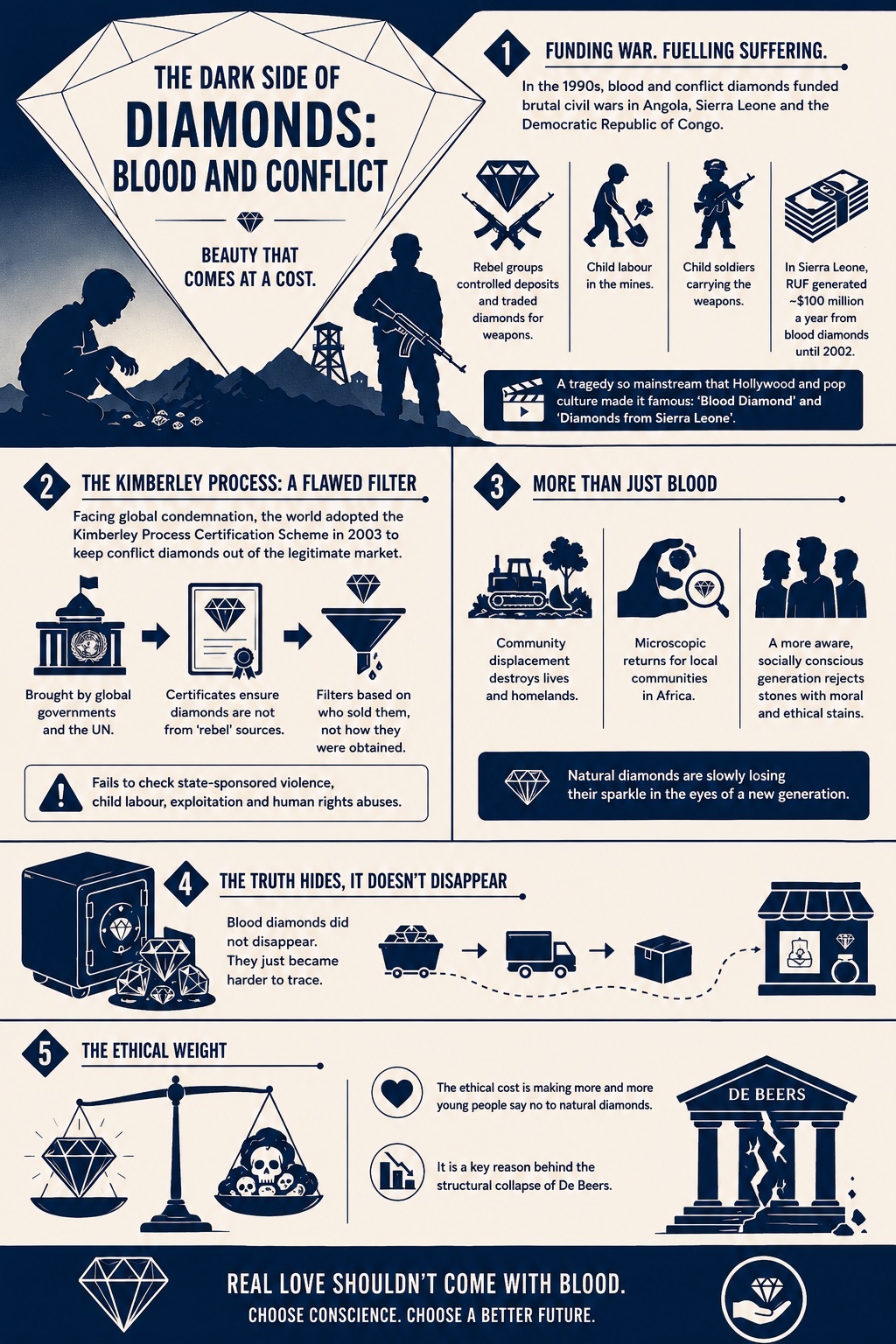
The ethical weight is a large part of what makes natural diamonds ‘wrong’ for an increasing number of young people globally. It is also another reason for the structural collapse of De Beers.
Each of the above-cited reasons- the manufactured scarcity, the ethical weight, and the marketed myth did play a small role in hurting the diamond empire, but none was fatal on its own. The death blow came from a totally unexpected quarter: a laboratory.
Lab-grown diamonds are not fake; they are real diamonds. They have the same physical and chemical nature. Every piece of lab-grown diamond is pure crystallised carbon with the same hardness (10 on the Mohs scale), refractive index, and optical properties as a stone mined in any of De Beers’ mines.
General Electric produced the world’s first publicly verified synthetic diamond in 1954, using a method called HPHT (High Pressure High Temperature) growth.

HPHT method: It recreates the conditions deep in the Earth’s mantle that make carbon into its diamond form. A small diamond seed (a very tiny slice of an existing diamond, natural or lab-grown) is placed in a capsule with a carbon source, usually graphite, and a metal flux. The metal flux can be either iron, nickel or cobalt. The capsule is subjected to roughly 5–6 gigapascals of pressure, around 50,000 times atmospheric pressure and a temperature of 1,300–1,600°C. Carbon dissolves in the molten metal and crystallises in the cooler seed. A one-carat crystal takes around 1 week to 10 days to make.
Chemical Vapour Deposition: Works in a different manner. A diamond seed sits in a vacuum chamber filled with hydrogen and a small percentage of methane. The gas molecules are broken apart by a plasma created by microwaves. Carbon atoms are then deposited layer by layer onto the seed at lower pressures and temperatures around 700–1,200°C. It also takes several days depending upon size and clarity.
Both processes yield gem-quality material. HPHT historically produced more yellow or brown stones that often needed treatment; CVD can more readily yield colourless material, though both methods have improved dramatically in recent years.
For decades, these methods stayed limited, producing only industrial tools and drill bits. What changed the market was not the technique itself, but scale.

In the 1950s, Chinese company Zhengzhou was building industrial abrasives and struggling with imported industrial diamonds that were hard to source. To solve this, Chinese researchers started building their own HPHT press and finally succeeded in 1963. However, the production stayed limited to industrial tools.
In the 1980s, an engineer from Zhengzhou returned to his hometown in Zhecheng and opened a factory in a region that was known for chilli farming. Workers trained in that factory slowly started opening their own ventures; with government support for production enhancement, the town slowly transformed. After nearly 4 decades, the town of Zhecheng, once known for chilli farms and with zero diamond mines anywhere around it, became the single largest producer of lab-grown diamonds in the planet. Henan province, where Zhecheng is located, now accounts for nearly 80% of China’s output of lab-grown diamonds. The scale was a result of decades of continuous growth, process enhancement, attempts to lower energy and costs and building capacity. China’s share in the global output is estimated at 60-63%.
Lab-grown diamonds were once premium alternatives to natural diamonds. But China’s scale has flooded the market, just like most other markets. Lab-grown diamonds are now selling cheaper and cheaper, even 90% cheaper than their price just years before, all because of the sheer scale.

China is not the only country dominating the lab-grown diamond story. India remains one of the major producers using the CVD method, and Surat is still the world’s dominant cutting and polishing hub. The workshops in Surat do not care whether the diamond is natural or lab-grown. Many firms that once cut only mined stones now process both. In recent periods, India’s polished lab-grown diamond export volumes have rivalled or exceeded those of natural stones.
The Indian government has actively promoted the sector through research funding. The India Centre for Lab Grown Diamond at IIT Madras was announced in the 2023 Union Budget. Duty reductions on seeds, and indigenous equipment development aimed at reducing reliance on imported rough, and a green energy push are all working to promote the industry.
The USA and Singapore are also making lab-grown diamonds. So are South Korea, Russia, Japan and others.
Survey after survey has pointed out that Gen Z and Millennial buyers are more inclined to buy lab-grown diamonds, not just for ethical reasons, but for economic reasons too. The Knot’s Real Weddings Study reported that more than half the couples in the US preferred a lab-grown diamond for the ring. Pandora, one of the world’s largest jewellery brands, has dropped natural diamonds altogether from its designs and uses only lab-grown diamonds. It has increased sales.
The hype and myth built around the romance of diamonds does not work anymore. Today’s buyers are less and less likely to fall for that. They are not going to spend 2 month’s salary on a single ring when a lab-grown diamond that looks and feels exactly the same, and does not have conflict stains on it, is available at a much lower price.
In about a decade, lab-grown diamonds have come from a small-scale output limited to industrial tools to a dominating market force that has caused the fall of the giant named De Beers. In 2020, the global output of gem-grade lab-grown diamonds was around 6-7 million carats. In 2024, the global output was pegged at 22 million carats. China alone exported around 35 million carats of rough diamonds in 2025.
India is running around 8000-10,000 CVD reactors, mostly in Surat. In the financial year 2025-26, India’s export of lab-grown diamonds exceeded its natural diamond exports, 18.8 million carats compared to 16 million carats. The USA sits at a distant third position, with only 1 million carats. The global natural diamond production is still at 120 million+ carats. But lab-grown diamonds have undercut them on a price scale, with their supply flooding with an industrial scale, aided with customer preference.

The empire De Beers built by manufacturing scarcity is being undone, stone by stone, by the exact opposite: supply on an industrial scale.
The story does not end here. Lab grown diamonds now are produced at an industrial scale, agreed. But why is the world producing so much of them, using so much of energy and investment, just for bling and vibe?
No. Lab-grown diamonds have an entirely different tangent of utility, one that is probably soon going to be needed at a large scale too.
Earlier this year, a photo of NVIDIA chief Jensen Huang shaking hands with a CEO of a Chinese diamond materials company in Beijing went viral on Chinese social media. Amid the buzz and hype, a narrative that NVIDIA is already moving to fully adopt synthetic diamond cooling tech for its next-gen AI superchips spread like wildfire. Stocks of China’s lab-grown diamond manufacturers surged 9% on a single day. Firms like Henan Liliang Diamonds and SF Diamonds hit their maximum daily upper limits, and the synthetic diamond manufacturers earned over $7 billion in a day.
In reality, it was just hype. Physics works a bit away from the stock markets and retail sentiments. Over 90% of China’s synthetic diamonds are made with the HPHT process, which creates small stones suited for jewellery, not chips. Tech-grade AI chip cooling needs ultra-thin diamond sheets. Those can only be made with the CVD process, where carbon gas is baked atom-by-atom in a vacuum chamber to grow perfectly flat, wafer-thin, large-area diamond.
AI chips have a thermal bottleneck. Copper spreaders and liquid cooling struggle above roughly 1,400–2,000 watts under sustained load. Every 10 degrees rise in temperature nearly halves the reliability of an electronic component and over a third of divice failures trace back to heat. Roughly 40% of an AI data centre’s total energy bill is now spent on just moving heat out of the building. That means thousands of watts are drawn just to prevent melting, throttling the processing speed.
While the retail frenzy made Chinese HPHT companies rich, Akash Systems, a California-based company has already commercialised the world’s first Diamond-cooled NVIDIA H-200 GPU servers to an Indian cloud provider NxtGen AI. Akash used a patented GaN-on-Diamond CVD process. Instead of relying on traditional copper plates, they fuse an ultra-pure, atom-thin sheet of synthetic CVD diamond directly onto the hot semiconductor substrate. The reason: diamond pulls heat away 5 times faster than copper. It is also an electrical insulator whose thermal expansion can be engineered to match silicon.
After delivering diamond-cooled NVIDIA H200 systems to India’s NxtGen AI, Akash System then announced a $300 million order for servers built around AMD’s Instinct MI350X GPUs.
NVIDIA has announced that its upcoming Vera Rubin GPUs, which are going to push 1,800–2,300 watts of thermal design power per chip, will use a diamond-copper composite heat spreader paired with 45 degrees of direct liquid cooling. Researchers at MIT have already used diamonds to handle heat bottlenecks in high-power wireless chips for 6G tech and satellite applications.
This is the cutting edge of diamond utility, the structural shift that transforms an entire industry limited to bling and sentiment into something future-ready. Lab-grown diamonds have collapsed a century-old empire built on myth and hype of sentimentality and romanticism, and are now getting ready to be a part of the technology infrastructure taking humanity forward. Elsewhere, some advanced labs are already working to see whether diamond can work not just as a thermal management material, but as a semiconductor material itself, to build indestructible microchips for deep space research and quantum computers. Turns out, diamonds were never about just the sparkle and shine after all.

The best ability of Indian refineries is that they can switch between Gulf crude, Russian Urals, and Venezuelan heavy oil. They were built with deep conversion capacity, with units that crack the heavy, sulphur-laden bottom of the barrel into clean diesel and petrol.

Why is India delaying or taking so much time to make this deal possible? There is no single answer to that, but if we put the pieces together, India’s go-slow approach starts to make sense and more like a strategy. It rests on five calculations.

Indian investigations now combine device data with WhatsApp chats, CCTV, CDRs, metadata, witness accounts and records held by technology companies, but each source has limits and must be interpreted before responsibility can be attributed reliably.


