


Every BRICS summit unfailingly revives the spectre of de-dollarisation, generating breathless headlines about an imminent monetary rebellion against the Western financial order. Ahead of the 18th BRICS Summit in New Delhi, speculative commentary once again talked about a possible supranational currency similar to the euro and an aggressive, centralised rival to the SWIFT messaging network.
However, host nation India used its chairship to draw an unambiguous line between geopolitical posturing and macroeconomic reality. Speaking after the summit, India’s BRICS Sherpa and Secretary (Economic Relations) in the Ministry of External Affairs, Sudhakar Dalela, stated unequivocally that there is no proposal for a common BRICS currency on the table.
While all member states agree that systemic vulnerability to Western financial sanctions and dollar dominance must be curtailed, they remain fundamentally divided on the methods, objectives, and institutional architecture required to achieve that autonomy. The resulting tension pits sanctions-hit members seeking an insulated financial fortress against non-aligned emerging powers determined to protect their integration with global capital markets.
At the New Delhi summit, the group confirmed that there is no proposal for a common BRICS currency “as of now”. There is no official launch of a single messaging grid meant to knock SWIFT off its perch. What members did endorse is slower, more technical work: linking national payment systems, settling more trade in local currencies, and asking the BRICS Payment Task Force to keep hunting for payments that are fast, cheap, accessible and safe — with the explicit caveat that there is “no one-size-fits-all approach”.
This is how India separated three things that are constantly mixed up: a common currency, a centralised SWIFT rival, and interoperable national payment systems. BRICS will now focus on the third, not the more glamorous first two options.
The New Delhi Declaration, adopted by consensus on 12 September, is a long document. But on money, it is short and careful. Leaders acknowledged work already done to study “the cross-border interoperability of payment and messaging channels” and discussions on promoting trade settlements and investments in BRICS local currencies, “while respecting national priorities”. They encouraged the Payment Task Force to continue, building on the Kazan (2024) and Rio (2025) guidance on the BRICS Cross-Border Payments Initiative.
The declaration states that the members acknowledge that there is no one-size-fits-all approach, and called for the BRICS Payment Task Force to “continue discussions, building on the ongoing work, to facilitate practical solutions for cross-border payments among BRICS countries, which are fast, low-cost, more accessible, efficient, transparent, and safe.”
The text does not name the dollar as an enemy. It does not announce a new unit of account. It does not create a BRICS SWIFT. It asks the New Development Bank to expand local-currency financing. It leaves settlement and depositary infrastructure at the level of technical dialogue.
India’s briefing after Day One was even plainer. Sudhakar Dalela, Secretary (Economic Relations) in the Ministry of External Affairs and India’s BRICS Sherpa, told the press: “There is no proposal in the BRICS for a BRICS currency as of now.” Local-currency settlement, he said, had been under discussion for some time. India sees it as a practical way to cut transaction costs in bilateral trade, “encouraged as complementary to the global payment and settlement system”, not as a substitute for it.
That wording is important. Complementary means the dollar, SWIFT and correspondent banking remain in the picture. India is not offering BRICS as an exit from the existing order. It is offering extra routes.
The same caution showed up before the summit. People familiar with the talks told Bloomberg that Prime Minister Narendra Modi favoured linking central bank digital currencies for bilateral settlement, but that a single bloc-wide payments network, something that could be read as a challenge to the dollar or to SWIFT, was unlikely. Commerce and Industry Minister Piyush Goyal, speaking at the BRICS Business Forum, urged members to link payment systems and trade in one another’s currencies. He did not ask them to mint a new one. External Affairs Minister S Jaishankar had clarified in 2024 itself that there is no proposal to start a new currency to compete with the US dollar.
The common-currency story did not begin in Delhi. It has been a Russian and Brazilian political project, periodically dressed up as a banknote, and supported by Iran. For more than two years, “BRICS currency” and “BRICS versus SWIFT” have travelled faster than any official text. Souvenir notes have been photographed in leaders’ hands. Private foundations have published gold-and-basket designs. Russian ministries have briefed journalists on a new clearing house. And American President Donald Trump has threatened tariffs over such a currency.
After 2022, when major Russian banks were cut off from SWIFT, Moscow began to talk openly about a dollar-independent settlement mechanism. President Vladimir Putin and Russian officials framed a “BRICS payment system” as strategic insurance against sanctions. In Brazil, President Luiz Inácio Lula da Silva made the political case in plainer language. In 2023 he asked why every country had to base its trade on the dollar, and advocated for an alternate accounting unit similar to the pre-euro European Currency Unit. However, the Central Bank of Brazil has quietly resisted these initiatives, recognizing that an illiquid clearing ledger cannot be reconciled with Brazil’s inflation-targeting framework, deep capital markets, and floating currency.

At the Johannesburg summit that year Lula said leaders had approved a working group to study a BRICS “reference currency”. Aleksei Mozhin, then Russia’s executive director at the IMF, floated a name that stuck in commentary: R5, because the currencies of first five members — real (Brazil), rouble (Russia), rupee (India), renminbi (China) and rand (South Africa) — all begin with R. Paulo Nogueira Batista Jr, a former Brazilian NDB vice-president, later wrote that the idea originated in Russia and that Johannesburg language was softer than some wanted, in part because of Indian resistance.
None of this produced a legal tender. What it produced, repeatedly, was mock, privately designed souvenir backnotes.

During the 2023 Johannesburg summit, images of a purported BRICS banknote printed with the flags of the original five members and a BRICS coin spread on social media. However, no such currency had been issued officially. Days after the summit, Russia’s ambassador in South Africa presented a symbolic 100-unit note to the UAE’s envoy — a souvenir, not a central-bank liability. In Kazan in October 2024, Putin was photographed holding a mock 50-unit note. However, official captions did not call it a currency. A similar 200-unit note also emerged, and all three are available for purchase online as ‘Commemorative Souvenir Fantasy Banknotes’. The notes were designed and printed by private enthusiasts, not any central bank. However, the prop led many to believe that a BRICS currency had been unveiled.
While the designs were not official, a more serious private design sat behind the props. In 2023, the Unit Foundation published a white paper and FAQ for a digital settlement instrument called the Unit: 40 per cent physical gold by weight, 60 per cent a basket of BRICS currencies, issued through distributed nodes rather than a single European-style central bank. The concept is a wholesale unit of account. In March 2024, Yuri Ushakov, a foreign-policy adviser to Putin, said a Business Council working group was looking at such plans. On 31 October 2025, Russia’s International Research Institute for Advanced Systems (IRIAS) ran a tiny pilot — on some accounts, 100 tokens — to test custody and transfer.

Lula kept the political flame alive from a distance at Kazan, arguing again for alternate means of payment without replacing national currencies. However, by Rio in 2025 and Delhi in 2026, the framework had moved off a common currency and onto interoperability, as other member countries were not supportive of the idea.
If the currency is the romance, the payment architecture is the engineering. Several proposals have tried to build a path around the SWIFT system of international money transfer. The Society for Worldwide Interbank Financial Telecommunication (SWIFT) is a secure global messaging network that financial institutions use to quickly and reliably transmit standardised instructions for cross-border payments and securities transactions. Established in 1973 and headquartered in Belgium as a member-owned cooperative, SWIFT does not actually hold funds, clear money, or manage accounts itself; rather, it serves as the international banking system’s trusted communication backbone, assigning unique Business Identifier Codes (BICs) to ensure payment orders route accurately between correspondent banks.
With more than 11,000 institutions connected across over 200 countries and territories, SWIFT’s ubiquity makes it the de facto nervous system of global commerce—a position that also makes access to it a powerful geopolitical tool, as disconnecting a nation’s banks from the network effectively severs them from the mainstream international financial system.
The sanctions-hit Russia and Iran view non-Western financial architecture as an existential shield against Western economic containment. Following the freezing of roughly $300 billion in sovereign foreign exchange reserves and the expulsion of its major lenders from SWIFT in 2022, Moscow has relentlessly championed centralised alternatives. Russian proposals have included “BRICS Clear,” an independent securities depository designed to bypass Euroclear, and “BRICS Bridge,” a multi-CBDC settlement grid modelled after the Bank for International Settlements’ mBridge project. Iran has pursued a similar trajectory, integrating its national SEPAM messaging system with Russia’s SPFS and advocating for direct multilateral clearing tokens.
National systems already exist as an alternative. China’s Cross-Border Interbank Payment System (CIPS) clears and messages in renminbi and now reaches well over a hundred jurisdictions. Russia’s SPFS is a financial-messaging backup built after the 2014 sanctions and expanded after 2022. India has UPI and RuPay for retail, and SFMS for domestic interbank messages. Brazil has Pix. These are different systems: a Chinese wholesale RMB rail, a Russian SWIFT-like messenger, an Indian retail instant-payment stack, and a Brazilian retail instant-payment stack.

BRICS Pay, launched as a research project by the BRICS Business Council in 2018 around the Johannesburg summit, tried to sit on top of those rails. An early consumer-style pilot was discussed in South Africa in 2019. The 2020 Moscow-period BRICS work created a payments task force at official level; the Business Council kept the commercial brand. At the BRICS Business Forum in Moscow in October 2024, organisers demonstrated QR payments with promo cards at the World Trade Centre. The same week, Kazan leaders talked about the Cross-Border Payments Initiative.
BRICS Bridge was the 2024 Russian official bet: a cross-border settlement layer using central bank digital currencies, so that correspondent banks with access to dollar clearing would no longer sit in the middle. The Economist reported Moscow wanted progress within a year. The design drew on lessons from mBridge, the multi-CBDC platform built with the Bank for International Settlements and the central banks of China, Hong Kong, Thailand and the UAE (Saudi Arabia later joined the orbit). BIS later stepped back from mBridge governance. Russia hoped BRICS Bridge would be the sovereign version. Reception to the proposal, as Foreign Policy put it, was lukewarm.
BRICS Clear was the securities cousin. Russian Finance Minister Anton Siluanov and a Moscow high-level seminar in October 2024 described a distributed-ledger depositary that would do inside the grouping what Euroclear and Clearstream do for Western markets — keep and settle securities when Western infrastructure is closed to Russian names. The Kazan Declaration agreed only to “discuss and study the feasibility” of such an independent settlement and depositary infrastructure, on a voluntary basis.
DCMS — a Decentralised Cross-border Messaging System associated with St Petersburg researchers and the BRICS Pay commercial stack — is the most explicit SWIFT-shaped proposal: peer nodes in each country, encrypted messages, claimed compatibility with familiar SWIFT formats, no single Belgian switch.
Russia, under sanctions, has pushed the most centralised and most political designs: the country advocates both a centralised currency and a SWIFT-like messenger for financial transactions. Brazil has supplied the rhetoric of monetary justice. Brazil has provided political rhetoric without corresponding institutional backing. Brazilian President Luiz Inácio Lula da Silva has been advocating for an alternate accounting unit similar to the pre-euro European Currency Unit.
Iran wants any system that clears oil, goods and reserves outside Western compliance. It will use yuan, roubles, dirhams, gold or a BRICS currency if the other side will accept them. The country also supports a replacement of SWIFT.
China occupies a distinct, self-interested position that conflates with Moscow’s de-dollarisation campaign. Accounting for more than half of the bloc’s aggregate economic output, Beijing has little appetite for a supranational currency that would dilute the People’s Bank of China’s domestic authority. Instead, China’s operational focus remains the global expansion of its proprietary Cross-Border Interbank Payment System and the internationalisation of the renminbi and e-CNY. China has built the CIPS that already works at large scale. A greenfield currency or payment system would only dilute CIPS, making Beijing reluctant to invest in a jointly governed multilateral network.
Most other BRICS members are not very interested in a BRICS currency or a separate payment system. They don’t want to present BRICS as a rival to the existing system, and their economies are closely linked to the US dollar.

Saudi Arabia has no interest in a gesture that endangers the dollar oil system or the American security relationship. It will talk yuan invoices with China and sit in BRICS photographs. But it will not lead a campaign to dethrone the dollar. Riyadh’s silence in the currency debate is a position.
The United Arab Emirates is a dollarised international financial centre that also runs a rupee–dirham corridor with India and participates in yuan infrastructure. Abu Dhabi likes optionality. It does not like being drafted into an anti-Western payments bloc. A network that carries that identity becomes harder for the UAE to use. The emirates will also not like to lose the status of global financial centre by taking a direct anti-west, anti-dollar position.
Indonesia, a full member from 2025, also has a similar opinion. Jakarta will settle with India in rupees and rupiah and write rules for rupiah–Singapore dollar trades. But it is not available for a project whose point is to end the use of US dollar.
South Africa has long warned against moving too fast on de-dollarisation if that scares off Western capital. Pretoria supports local-currency trade and African payment experiments such as PAPSS. It is not a sponsor of a common currency or of a confrontation with SWIFT.
Egypt wants cheaper settlement and has deepened local-currency talk with China. Ethiopia is in the same category.
And finally, India is the explicit veto on a common currency and the principal brake on a branded SWIFT rival. The government have said so in public in multiple occasions. New Delhi will do UPI corridors, CBDC links and rupee invoicing. It will not mint an R5 or a Unit currency, and it will not join a CIPS or SPFS-centred political network that can be sold as anti-dollar.
Indian ministers have not been ambiguous. In December 2024, days after Donald Trump’s first post-election tariff threat against a BRICS currency, External Affairs Minister S. Jaishankar said in Doha that BRICS countries had no interest in weakening the US dollar. He has also said India has “never been for de-dollarisation”. The Reserve Bank of India has described rupee internationalisation as a way to reduce invoicing friction, not as a campaign against the greenback. Former RBI Governor Shaktikanta Das treated local-currency trade as risk management, not ideology.
On 7 August 2026, after BRICS trade ministers met in Jaipur, Piyush Goyal was blunt: “India is not in favour of a BRICS currency. We do not support the introduction of any such BRICS currency scheme; India opposes it.” That line was delivered well before the leaders arrived in Delhi. Dalela’s “as of now” after the summit was the diplomatic version of the same position.
On payments, the government has drawn a second line. Officials have been willing to talk about UPI-style links and CBDC-to-CBDC corridors. They have been unwilling to support a unified intra-BRICS settlement network that would look like a political alternative to SWIFT. RBI Governor Sanjay Malhotra said in August that a dedicated task force was looking at two tracks — linking fast-payment systems and connecting CBDCs — and that both remained “at the discussion stage”. “Various methods, various options are on the table.” That is the language of a central bank that will pilot, not proclaim.
India has acted as the primary institutional brake against both a unified currency and a politicised SWIFT substitute. New Delhi’s rejection of these schemes is neither tentative nor accidental; it is grounded in calculated macroeconomic and geopolitical self-interest.
A common currency, even a “reference” unit that starts as a unit of account, eventually needs a rule for issuance, a valuation method, and someone who absorbs losses when members’ inflation and interest rates diverge. The euro required a treaty, a central bank and years of fiscal argument. BRICS members do not share a fiscal compact, a capital-account regime or a political union. India will not park the RBI’s inflation mandate inside a committee whose largest economy is China.
The economic prerequisite for a common currency is the Mundell-Fleming “Impossible Trinity”: an economy cannot simultaneously maintain an independent monetary policy, a fixed exchange rate, and free capital flows.
The Eurozone required decades of institutional integration, fiscal convergence criteria, and legal harmonisation, yet still experienced crises due to fiscal divergence among member states. BRICS economies feature extreme structural asymmetries: China runs immense trade surpluses with tightly managed capital controls, India operates a structural merchandise trade deficit with a partially convertible rupee, Russia is an isolated war-footing energy economy, and Brazil and South Africa manage freely floating currencies with independent central banks.
The Reserve Bank of India (RBI) cannot cede interest-rate determination or exchange-rate intervention powers to a multinational committee.
The defining calculation for New Delhi is the balance of power inside BRICS. China accounts for more than half of the bloc’s combined GDP. Any unified monetary unit or centralised clearing switch would inevitably be anchored to Beijing’s financial system and capital reserves. For India—which remains locked in border confrontations along the Line of Actual Control (LAC) and strategic competition across the Indo-Pacific—trading dependence on the US dollar for dependence on the Chinese Yuan (RMB) is a strategic non-starter.
De-dollarisation inside a group where China runs surpluses against most members is not a neutral rotation of currencies. India runs a large merchandise deficit with the BRICS grouping, especially China. Local-currency settlement on those terms means India accumulating or owing a surplus country’s money. Russia–China trade has already shown it: Russia became a large holder of renminbi due to trade in Chinese currency. Indian analysts have therefore asked whether “BRICS money” is not, in practice, yuanisation. New Delhi has no interest in testing that hypothesis with a shared note.
India treats BRICS as a platform for the Global South and for UN and IMF reform, not as an anti-Western alliance. A common currency is a political symbol before it is a payment tool. It would lock India into a project whose loudest sponsors are a sanctioned Russia and a China with which India still has several issues including an unsettled border. India’s policy of multi-alignment, maintaining cordial relations with Washington, Moscow, Brussels, the Gulf, the Global South will be harder if New Delhi joins a financial system designed to look like a challenge to the dollar.
On the other hand, Moscow and Tehran view the BRICS as an instrument to dismantle the Western-led order. Because the US and the European Union remain India’s largest merchandise export destinations, top sources of Foreign Direct Investment (FDI), and vital partners in technology and defence cooperation, building an aggressive counter-system to SWIFT contradicts India’s core national interests.
Even voices that dislike dollar “weaponisation” have rejected a BRICS currency for the same reason they reject a yuan peg: India should not surrender monetary sovereignty to a structure whose governance is contested. That argument is Indian, not American.
The American factor is not imaginary. After Kazan summit, President-elect Donald Trump posted that countries creating a new BRICS currency, or backing any currency to replace the dollar, would face 100 per cent tariffs. He later added threats of extra duties on countries “aligning themselves with the anti-American policies of BRICS” around the Rio summit.
India-US trade is large. Capital markets, technology supply chains and the diaspora economy all run through dollar plumbing. A theatrical anti-dollar communiqué would be cheap for Moscow and expensive for Mumbai. Jaishankar’s Doha remarks came days after the first Trump blast. Reports said that India feared a unified network would cast BRICS as an anti-dollar bloc. The New Delhi Declaration’s technocratic English — interoperability, national priorities, no one-size-fits-all — is written to be read in Washington as well as in Kazan.
It would still be a mistake to say India opposes a BRICS currency because of Trump. The sovereignty and China arguments predate his second term. What the threats did was punish loudness. India can deepen rupee-rouble accounts, float the e-rupee, and link UPI. It cannot afford to put a gold-basket souvenir on the summit stage.

It is notable that India is not defending SWIFT as a moral good. It is refusing to join a single political network that would sit next to CIPS and SPFS and be sold as the BRICS answer to Belgium.
A financial messaging system is power. SWIFT’s leverage comes from ubiquity plus the ability of Western states to lean on a central operator. A BRICS clone with a different headquarters does not abolish leverage; it relocates it. If the working core is CIPS, the centre of gravity is Beijing. If the working core is SPFS, the centre is sanctioned Russia. India has stayed outside CIPS. It will not build its cross-border future as a junior node on someone else’s system.
There is also a product interest. UPI is one of the few Indian public-digital goods with a global pitch. NPCI International has already taken it to the UAE, Singapore, France, Sri Lanka, Mauritius, Bhutan, Nepal and other corridors. A “BRICS Pay” or “BRICS Bridge” that swallows UPI into a Russia- or China-designed protocol would replace an Indian standard with a committee standard. New Delhi would rather export UPI and experiment with the e-rupee than support a new brand.
A unified grid would also force a compliance choice India does not want to make in public. Russia needs a sanctions-proof channel. India still needs access to dollar funding, American technology, and a trade relationship with the United States that is larger and more balanced than its BRICS deficit.
That is why the preferred official model looks more like Project Nexus than like a new SWIFT. Nexus, designed at the BIS and now being taken forward by a company that includes the RBI among its founding central banks, coordinates two domestic instant payments rather than creating one new ledger. Each country keeps its own system, its own AML stack and its own regulator. The cross-border element is a gateway and an FX provider, not a new sovereign.
If a BRICS unified currency and SWIFT-clone are out, what is in?
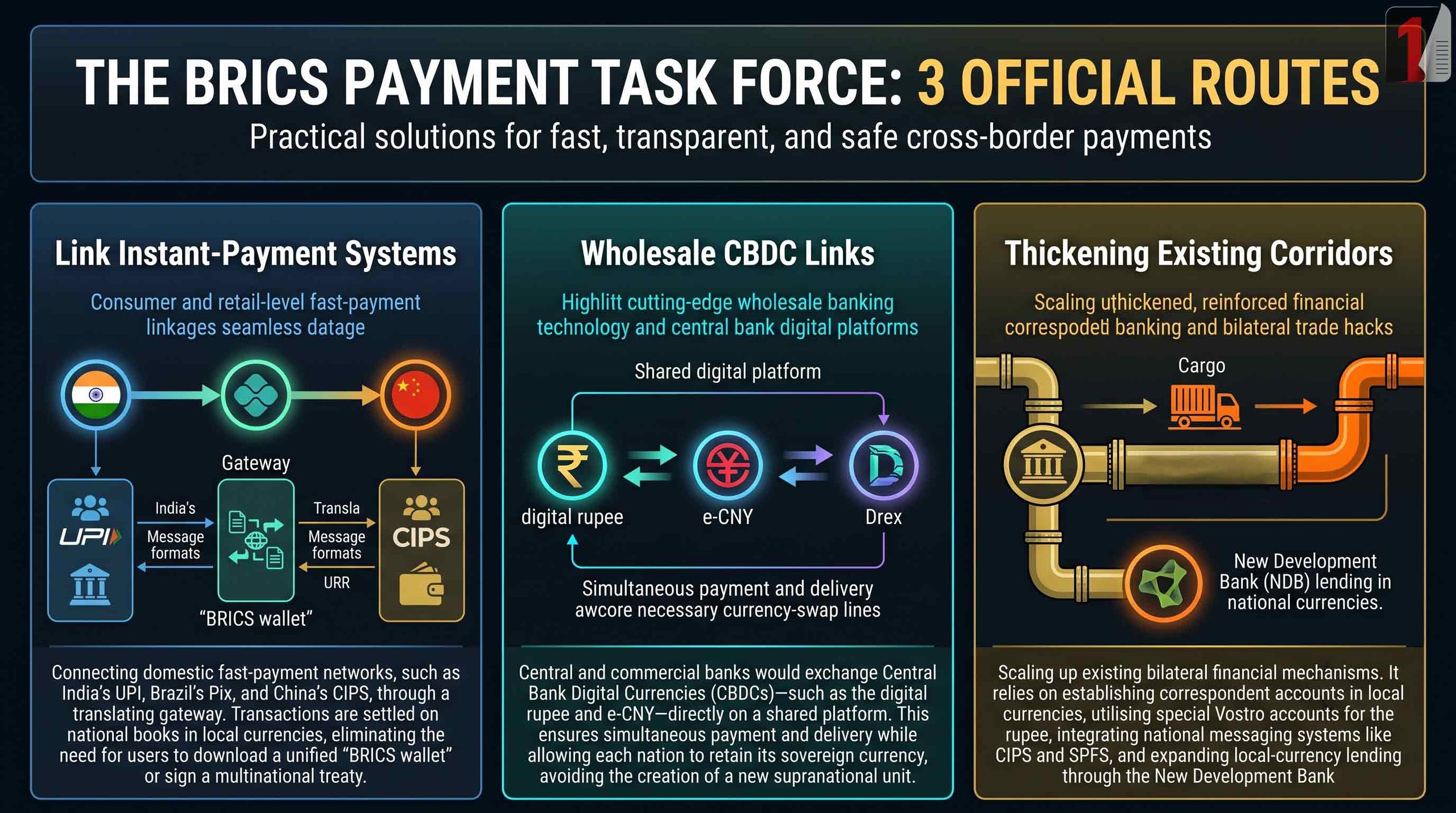
The BRICS Payment Task Force is a group of central-bank and finance-ministry experts. Its mandate, restated in Delhi Declaration, is to find “practical solutions” for payments among members that are fast, low-cost, more accessible, efficient, transparent and safe. The method is study and voluntary adoption, not a forced migration date. Three official routes sit on the table.
First, link instant-payment systems. An Indian importer’s bank sends a rupee instruction on UPI or SFMS. A gateway translates the message format and currency. A Chinese or Brazilian bank credits the exporter on CIPS or Pix. Each leg settles on national books. The user, in the ideal case, never downloads a “BRICS” wallet. This is the Nexus logic applied to a political club that cannot agree on a treaty.
Second, link CBDCs at the wholesale level. Central banks or commercial banks exchange digital rupees, e-CNY, digital roubles or Drex on a shared platform. Payment and delivery can be simultaneous. India has pushed this option because it keeps the rupee as the rupee. It does not require a Unit or an R5. It does require currency-swap lines and rules for imbalances — which is why India still calls it a discussion, not a launch.
Third, thicken what already works. Correspondent accounts in local currency, special vostro accounts for the rupee, CIPS and SPFS where members choose them, NDB lending in national currencies. About 96 per cent of India–Russia trade already moves through rupee-rouble mechanisms. Russia–China trade is almost entirely in yuan and roubles. The task force’s job is to make those bilateral hacks less clumsy.
Delhi also kept open a narrower financial path: a possible BRICS Risk Lab at GIFT City, more talk on reinsurance capacity, a phased New Investment Platform, and NDB local-currency loans. These are the unglamorous cousins of a currency. They are also the parts India can host without rewriting monetary law.
BRICS Pay is the name that causes most of the confusion.
It is a Business Council project, developed since 2018 by a consortium of banks, fintechs and a Russian-led operating company JSC BRICS Pay, with an app entity in Dubai. Its promoters say it is not a SWIFT replacement, not a Visa rival, not anti-dollar and not a sanctions-evasion tool. They describe a distributed system of gateways: Russia’s SBP and Mir, India’s UPI and RuPay, Brazil’s Pix, China’s UnionPay and wallets, South Africa’s PayShap, and so on, talking through a common protocol. Retail users would scan a QR; the app would debit a linked card or wallet and credit the merchant in local currency. A B2B channel would target company invoices from a few thousand dollars upward. A messaging layer, DCMS, would carry bank-to-bank instructions without a single operator who can pull a country’s plug.
During the Delhi summit, the Russian Direct Investment Fund, JSC BRICS Pay and a local BRICS Pay India vehicle agreed to explore integration with Indian infrastructure and possible pilots. However, that is a commercial memorandum on the sidelines of a summit. It is not part of the New Delhi Declaration.
But its overlap with the official track is real. Both talk about interoperability, sovereignty and local currency. Both point at UPI, Pix, CIPS and SPFS. However, BRICS Pay is run by a business-council and private operators, and is already marketing an app and claiming message-throughput numbers. On the other hand, BRICS Payment Task Force is mandated with exploring various ways of bilateral transactions withing BRICS, and no solution has emerged yet.
Under the hood, BRICS Pay relies on the Decentralized Cross-Border Messaging System, developed by researchers associated with Saint Petersburg State University. DCMS operates as a distributed ledger where participating financial institutions host independent communication nodes, designed to withstand network disruptions and process encrypted interbank instructions without passing through SWIFT hubs in Belgium.
However, sovereign regulators like the Reserve Bank of India maintain strict institutional distance from such private distributed networks. Central banks cannot surrender oversight of capital flows, anti-money laundering enforcement, and systemic liquidity monitoring to an unverified private messaging layer. While promoters market BRICS Pay as a ready-made commercial solution, it remains an external commercial project that lacks regulatory endorsement from the grouping’s major monetary authorities.
The Delhi summit did not kill the dream of a BRICS money. But it decisively separated practical financial engineering from political posturing. The summit demonstrated that the expansion of BRICS has diluted, rather than strengthened, the appetite for radical anti-Western experiments, as new members are not as anti-west as some of the original members.
De-dollarisation remains an extraordinarily complex, multi-decade undertaking constrained by the macroeconomic realities of global capital. Sovereign states can alter the currency mentioned on a commercial trade invoice far more easily than they can change where global capital is stored. As long as developing economies maintain capital controls and illiquid domestic debt markets, the US dollar will retain its pre-eminent role as the world’s primary store of value and benchmark for risk.
India’s position is internally consistent. A common currency would cost sovereignty and likely enlarge the yuan. A SWIFT rival would relocate dependence rather than end it, and would brand BRICS as an anti-Western camp India does not wish to join. The alternative India will actually work on is unheroic: UPI corridors, CBDC experiments, rupee invoicing where the other side will hold rupees, and a task force that writes options instead of issuing notes.
The Delhi Declaration formula — local currencies, linked systems, no single design — is easier to print than to run. However, the proposed system faces several challenges.
Local-currency settlement only works if the surplus country can spend or invest what it earns. US dollar works as an international trading currency because a country that earns dollar by exporting can use it to import anything from anywhere, because dollar is accepted by every country in the world. The EURO is reaching that status. But for other currencies, that is not the case. If a country accumulates a specific currency that it can’t use elsewhere, it creates a real problem. And that is the issue with trade using other currencies.
India–Russia is a prime example of this. After 2022, most bilateral trade shifted from the dollar and into Special Rupee Vostro Accounts. India buys far more from Russia (chiefly oil) than it sells. As a result, rupees piled up in Russian accounts in Indian banks. Moscow at one point even spoke of billions of unused rupees and even of converting them into another currency. To save the situation, New Delhi widened what those balances could buy — gilts, some corporate paper, more Indian exports — and Russian bankers later said the overhang was no longer a major hurdle. However, this was an one-time solution and can’t be used every time a country accumulates currency it can’t spend.
A deficit country cannot force a surplus partner to warehouse a managed, not-fully-convertible currency. Inside BRICS that pattern repeats: India is in deficit with China; several members would be in deficit with China in any yuan-heavy clearing. Without swap lines, investable assets and a willingness to buy the partner’s goods, “pay in local currency” becomes a blocked account with a nicer name.

A cargo can be paid in rupees or yuan and still be priced in dollars. Oil, metals and a large share of emerging-market exports are still dollar-invoiced even when the buyer or the seller is not American. The dollar also sits in the middle of most rupee, real, rand and even yuan foreign-exchange trades. Major commodities are priced in dollar which are converted to applicable local currencies. Even foreign exchange rates are dependent on dollar. Almost all currencies are converted to each other through dollar conversion first.
Economics commentator Martin Wolf’s distinction before the summit was the right one: countries can change the currency on the invoice more easily than they can change where capital lives. As long as India and China keep capital controls, neither rupee nor yuan can replace the dollar as a reserve and funding currency. Local-currency corridors cut correspondent-bank fees. They do not dethrone the unit in which risk is measured.
US allows capital to move freely without exchange controls, but both India and China maintain exchange controls to protect their currencies. As a result, it becomes almost impossible to replace the dollar.
UPI, Pix, CIPS and SPFS were built for different countries. They do not automatically talk to each other. Banks still have to agree on message formats, fraud rules, sanctions checks and who takes the currency risk overnight. That work is slow. Russia and Iran want a route the West cannot block. India, the UAE, Indonesia and Saudi Arabia do not want to look as if they are building a system that rivals the western system. China already has CIPS and will not replace it with a joint BRICS brand. Those clashes are why the Task Force said there is no single model — and why that line is the most honest one in the declaration.
The New Delhi summit stripped the de-dollarisation narrative of its theatrics, drawing an unmistakable line between political grandstanding and macroeconomic reality. Rather than minting a mythical shared currency or erecting an ideological fortress to rival SWIFT, BRICS has pivoted toward pragmatic financial plumbing. Through its resolute veto, India made clear that it will not sacrifice monetary sovereignty, trade Western integration for an anti-American bloc, or substitute dollar hegemony with Chinese yuan dominance. The bloc’s actual path forward is neither glamorous nor revolutionary; it is a cautious, technocratic push toward bilateral settlement corridors, linked payment stacks like UPI, and wholesale digital currency experiments.
Ultimately, the dollar remains the undisputed anchor of global capital because changing the denomination of a trade invoice cannot bypass the fundamental constraints of capital controls and illiquid debt markets. Invoicing in national currencies cuts transaction friction, but it does not dismantle the architecture that safeguards global reserves and prices international risk. By acknowledging that there is “no one-size-fits-all” solution, BRICS accepted that real financial sovereignty is built through practical interoperability, not speculative fantasy notes. The future of multipolar finance will not arrive with the dramatic collapse of the existing order, but through the quiet, incremental construction of parallel roads.

India could close part of that gap by creating a dedicated Brahmaputra Dam Monitor, modelled on the Stimson Center’s Mekong Dam Monitor. It could combine satellite imagery with river-gauge readings, rainfall records and seismic data.

In Chinese political culture, the ability to master a river has long served as a stand‑in for the legitimacy of the state, long before hydropower even existed as a technology.

Lab-grown diamonds have collapsed a century-old empire built on the hype of sentimentality and romanticism, and are now getting ready to be a part of the technology infrastructure taking humanity forward. De Beers established a monopoly by selling a myth; science has broken it.


