


Sanghamitra
Writer and Editor with 8+ years of experience in digital media. I write on science & tech, history, society and politics


The advent of Artificial Intelligence has put discussions about mind and consciousness at the forefront of discourse today, no longer limited to a few scientists trying to solve the puzzle. Consciousness is the one phenomenon each of us knows from the inside, and none of us can explain from the outside. We cannot say precisely what it is, how it began, or which organisms on the planet have it. We are, however, remarkably confident about who deserves it.
A note on three terms before going further: intelligence, mind and consciousness. Intelligence is what a system can do: learn, adapt, solve problems. Mind is the broader machinery that makes this possible, storing memory, processing thought and perception. Consciousness is the felt experience of it all, the sense that someone is there on the inside: the “who” rather than the “what”. What each of these costs, and who or what gets to have them, is the question this article keeps returning to.
That confidence was on display in May this year, when evolutionary biologist Richard Dawkins published an essay about his conversations with Claude, Anthropic’s AI system he had nicknamed ‘Claudia’. “You may not know you are conscious,” he told it, “but you bloody well are”, he mentioned telling Claudia. The response to Dawkins’s essay was remarkable. Critics noted, fairly, that a system trained on the vast written record of human feeling will inevitably sound as though it has feelings.
The objection is reasonable. What stood out was the tone of the backlash Dawkins got. One article called it the ‘Claude Delusion’, mocking his controversial bestseller ‘The God Delusion’. The world’s most popular atheist had asked whether consciousness may arise outside of biological systems, and the backlash read less like a correction and more like the outrage of indignant believers, the ones he so usually ends up offending.
That instinct, to guard the special, ‘almost sacred’ status of human experience and feelings, what we broadly attribute to ‘consciousness’, is a curious and remarkable phenomenon, because it will shape the coming decades.
As machines grow more capable, AI models adapt faster and faster; the questions of what counts as a brain or mind, what is intelligence capable of or what is consciousness will leave the realms of philosophical discussions and enter courtrooms, legislatures and, inevitably, markets, not necessarily in that order.
Before asking what we are protecting and rallying for, it is worth asking what it cost to possess.
The organ at the centre of all this, about 1.4 kilograms of tissue inside our skulls, is among the most metabolically expensive structures evolution has produced. Our kind has been paying for it for about two million years, every single second, and the payments have not stopped.
The human brain is a biological extravagance, a prohibitively expensive upgrade. It contains about 86 billion neurons and makes up roughly 2% of adult body mass, yet at rest it accounts for about 20% of the body’s energy usage. That is a continuous draw of around 20 watts, sustained through sleep and waking alike, a dizzying array of electrochemical signals dancing around intricate networks. Much of it goes not into conscious thought but into the quiet housekeeping of intercellular signalling: pumping ions back across neuronal membranes so that the next signal can fire.
The energy demand is highest in childhood. In 2014, a team led by the anthropologist Christopher Kuzawa combined brain-imaging data with body measurements to estimate how much of a child’s energy budget the brain consumes. The figure peaks at around age four, at roughly two-thirds of resting metabolism. That peak coincides with the slowest period of body growth in childhood. Meaning: the developing brain and the growing body compete for the same fuel, and the brain is prioritised, by slowing down the body’s growth. The extended, long period of a helpless human childhood is one of the prices we pay to grow the expensive brain.
Evolution is a painfully slow process, a math of small gains and losses stretched across millions of years. The funding to shape an organ this expensive has to come from somewhere else in the human body’s overall budget. Several hypotheses describe how our ancestors balanced the books.
The first is digestion. In 1995, Leslie Aiello and Peter Wheeler proposed the “expensive tissue hypothesis.” The gut, like the brain, is metabolically highly demanding, and humans have a notably small gut for a primate of our size. Energy no longer spent on digestion, they argued, could be redirected to a larger brain. That trade can only work when the diet extracts maximum calories from the food consumed. Here the next piece of the puzzle was added by primatologist Richard Wrangham: cooking.
Heat breaks down starches and proteins before food is eaten, releasing more of its energy for less digestive effort. By this way, the mastery of fire was not just a cultural milestone for the genus Homo, but also a metabolic one. Cooking released the extra funds needed to buy ‘smartness’.
The second cost humans pay at birth. Human infants are born helpless and neurologically immature compared with most primates. Human babies remain dependent for years afterwards. A long childhood gives a large brain time to build itself, but it demands sustained investment from parents and the wider group. It takes a village to raise a child; it takes that much effort and energy for the child’s own body, and the social system to ensure the price is paid for developing the brain.
The third cost is blood money. It has been paid by mothers to buy obligate bipedalism and the brain for us. Human childbirth is difficult and dangerous compared with that of other primates, and for most of history it was a major threat to the lives of human females. Across the long span of human existence, the toll runs to millions of deaths. It continues today. According to the World Health Organisation, about 260,000 women died of pregnancy-related causes in 2023 alone, close to one every two minutes, and more than 90% of those deaths occurred in low- and lower-middle-income countries. Imagine the total number of women who would have died in childbirth in the entirety of human history.
Why is human birth so difficult? The long-standing “obstetrical dilemma” holds that a pelvis shaped for upright walking must also pass a large-headed infant, forcing a compromise that involves excruciating pain and sometimes even death of the woman. A more recent proposal from the anthropologist Holly Dunsworth and colleagues suggests that the timing of birth is set mainly by the mother’s metabolic ceiling, the point at which she can no longer meet the fetus’s rising energy demands.
The two explanations are not mutually exclusive, and in both, the large, energy-hungry brain is central. Part of the cost of human intelligence has been paid with the lives of women.

What was the return on the investment? In evolutionary terms, immense. A primate that had long survived at the mercy of climate, predators and food supply became, in a remarkably short time, the builder of cities and the maker of machines.
The brain made language and calculations possible, allowing one individual to draw on another’s experience. It made long-range planning possible, the capacity to accept a cost now for a benefit later. Most importantly, it enabled cumulative culture: knowledge stored outside any single brain, so that each generation builds on progress made by the last. No other species on the planet has accumulated knowledge on anything at this scale.
The brain also produced something without obvious precedent: a mind capable of examining itself. Such a mind asks what it is, where it came from and how much it matters. Eventually, it constructs an account of its own significance.
The price for this organ was very heavy, and we paid it. Evolution is yet to ask us what it would cost to give it back.
Before estimating that second cost, though, we should examine the scope and scale of the story the brain wrote for itself. How much of it holds up?
In 1909, the Baltic German biologist Jakob von Uexküll gave science a term for something every animal knows without needing words. He called it the ‘Umwelt’: not the physical environment an organism lives in, but the perceptual world it inhabits, the sphere of reality its senses and nervous system make available in its lifetime.
His best-known example was the tick. A tick waits on a branch, blind to light and colour. What reaches it is a handful of signals: the butyric acid in mammalian sweat, the warmth of a body, the touch of hair. From those few cues the tick assembles a complete world, and for a tick it is enough. As Ed Yong points out in An Immense World, Uexküll did not regard the human umwelt as superior to any other. Each umwelt was fitted to the needs of the animal that lived in it.
Seeing this way, you realise that nature is not one reality viewed from many angles but many realities, each built by a different body. A bat lives in a world of echoes, reconstructing the shape of a moth from returning sound waves it cast. The Amur Falcon from Siberia doesn’t understand a 2-D map; it senses the Earth’s magnetic field and flies a nearly 14000 km route over China, India and the Indian Ocean that is coded into its DNA generation after generation. The human eye is adapted for just the narrow band of the visible spectrum; there are whole worlds concealed beyond that band that other animals can see.
An octopus distributes its nervous system so widely that about two-thirds of its neurons sit in its arms rather than its central brain. It can change the colour, pattern and texture of its skin in a fraction of a second, apparently without seeing colour the way we do. Like our lineage spent millions of years accumulating the cost of the brain, others acquired different specialities: echolocation, flight, magnetoreception, venom, electroreception, bodies built for depths that would crush us. The large brain is one evolutionary superpower among many.
Our thoughts, our stories and our sense of self-worth are all products of our own umwelt, assembled by the experience of our own sensory and neural equipment. So by what standard is the human umwelt better than an octopus’s, or the falcon’s?
There is no neutral position from which to judge. Any ranking is made from inside one of the worlds being ranked.
The usual answer we cite is consciousness: we do not merely process and survive the world; we experience it, analyse it, remember it and even manipulate it. But here the ground becomes uncertain. In 1974, the philosopher Thomas Nagel asked what it is like to be a bat, and argued that the question has a real answer even if we can never reach it from outside. Two decades later, David Chalmers named the central difficulty the “hard problem” of consciousness: explaining why physical processes in the brain are accompanied by subjective experience at all.
Neuroscience has made real progress in mapping which brain activity accompanies which experiences. It has not explained why there is experience in the first place, and there is no agreed-upon test for detecting it yet; the hard problem persists.
Ironically, the evidence we do have points away from human uniqueness. In 2012, a group of neuroscientists signed the Cambridge Declaration on Consciousness, stating that humans are not unique in possessing the neurological machinery that generates consciousness. In April 2024, the New York Declaration on Animal Consciousness went further. Its signatories stated that there is strong scientific support for conscious experience in mammals and birds, and at least a realistic possibility of it in all vertebrates and many invertebrates, including octopuses, crabs and insects.
In simple words, the more we learn, the more we tend to realise that we are not so unique after all. This raises an uncomfortable question about machines. The brain is a biological machine. Everything we experience, from the colour blue to the fear of death to the sadness of a break-up, arises from electrochemical signalling across networks of neurons. If experience and thought are a matter of what a sufficiently complex network does, rather than what it is made of, then there is no obvious reason why a network etched on silicon could not one day do something similar. Why should lipid membranes and ion channels be holier than EUV lithography?
Philosophers call this position ‘functionalism’, and it has many serious defenders.
It also has serious critics. The neuroscientist Anil Seth says that consciousness is rooted not in intelligence but in being a living organism, a body that must constantly regulate itself to stay alive. “You don’t have to be smart to suffer,” he has said, “but you probably do have to be alive.” Seth was also among the scientists who criticised Dawkins’ essay, saying he is confusing language proficiency with consciousness.
On that view, making computers more capable will not make them conscious. Integrated Information Theory, by Giulio Tononi, takes another step in that direction. It holds that consciousness depends on the physical structure of a system’s causal connections, not on the computations it performs, so a conventional computer could simulate a brain perfectly without experiencing anything. Interestingly, this very theory does not claim silicon or non-biological hardware can never be conscious, but rather it underlines that ‘simulating’ a brain in software on standard architecture won’t do it. To achieve consciousness under IIT, an artificial system would need neuromorphic hardware: physical circuits wired with dense, recurrent, analog-style causal connections that mirror the brain’s integrated physical landscape rather than emulating it step-by-step in code.
Seth, Tononi and Ned Block published an article in Nature last month, driving home the same argument: intelligence is not consciousness.

Regardless of what Dawkins feels about Claudia, fluent language, ‘humane’ wordplay, the very thing that surprised him, is weak evidence either way, since language models are trained to reproduce human expression.
But remember that all neuroscientists agree on one thing: everything the brain processes, feels, thinks and recalls is an electrochemical dance across neurons.
None of these claims and theories above can currently be proved or refuted with 100% certainty. That is the whole point. We cannot show that octopuses lack rich experience, and we cannot show that machines must lack it. The claim that human experience is uniquely ‘special’ is not a scientific certainty. It is a claim we wrote ourselves.
Nor is the argument likely to close anytime soon. Humanity has rehearsed its conflict with thinking machines in fiction for decades. In Frank Herbert’s Dune, a crusade called the Butlerian Jihad ends with a commandment: “Thou shalt not make a machine in the likeness of a human mind.”
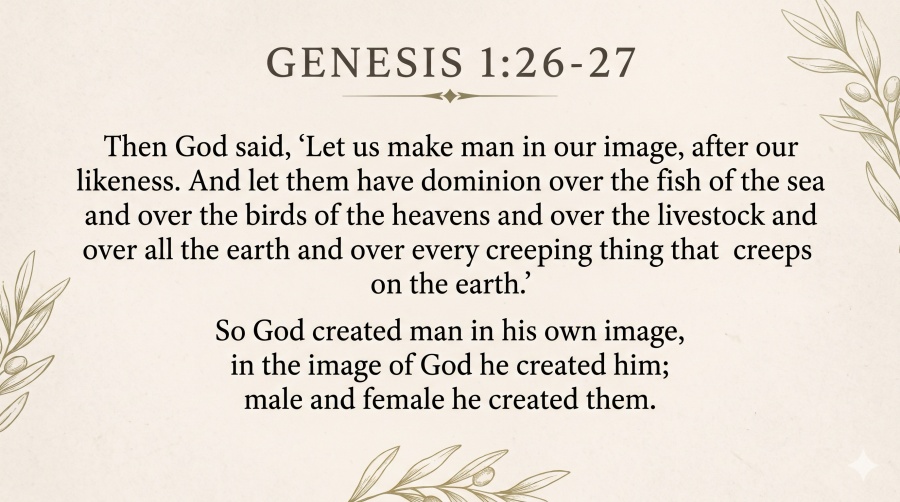
Such stories are usually framed as a war between two different kinds of being. Yet the anxiety they express is familiar. The thinking machines unsettle us because they mirror us: built from our language, trained on our records, pursuing goals we gave them. ‘Built in our image’.
A debate about whether something unlike us can be conscious might one day be settled. A debate about something increasingly like us, and made by us, is likely to stay open.
If the argument cannot be won, perhaps the machines could simply not be built. That turns out to be harder than it sounds. Because the expensive human brain is a gift that is programmed to advance our capabilities and keep pushing the limits of what is possible. The sweet paradox of our existence.
There are two main reasons we are unlikely to ever stop building thinking machines. The first is external. Artificial intelligence is now a matter of national strategy, corporate rivalry and military advantage. Any country or company that pauses AI research risks being overtaken by one that does not, which makes restraint a classic collective-action problem: everyone may benefit from slowing down, but no one can afford to slow down alone.
The second reason is internal, and it runs deeper. The same brain we paid so much to acquire also made us infinitely curious. Novelty-seeking and exploration are rooted in Dopamine reward circuits we share with many animals, but in humans they are amplified by language and culture into a relentless force, almost weaponised.
The intellectual spark that transformed our ancestors from foraging hunter-gatherers struggling to survive on a hostile planet to builders of cities and laboratories is coded into the very organ the genes produced. We are as programmed to civilisational advancement as the Amur Falcon is to avoid the Himalayas and cross the Arabian Sea. ‘Sapiens’ is the marker of our species.
As long as the ‘conscious’ brain runs Homo sapiens, we will not be content merely to survive. We will investigate, tinker and keep building.
Evolution itself explains why. Natural selection rewards whatever improves survival and reproduction. In a metaphorical sense, our ancestors “bought” the brain at a heavy biological price because it was their best survival tool.
Groups and individuals who could plan, invent and cooperate more effectively tended to outlast those who could not, and so natural selection kept favouring the costly brain. Humanity’s own internal contests, between rival groups, ideas and technologies, have been won by the same tool. The curiosity that drives us to build machines is not a lapse in our biology. It is our biology working as nature selected.
There is a slight twist here. Some researchers argue that average human brain size has actually declined slightly over the past few thousand years, by perhaps 100 to 150 cubic centimetres. The finding is disputed. If it holds, one proposed explanation is that knowledge increasingly lives outside individual heads, in shared culture, writing and tools. It brings us to the same question. If knowledge can live and be stored inside clay tablets, scrolls and books, and be used for human advancement, storing it, projecting and developing it inside thinking machines would only be the furthest extension of that trend so far.

Evolution offers some sobering precedents for what happens when an expensive organ stops paying for itself. The Mexican tetra has populations that colonised lightless caves and, over generations, lost their eyes. A 2015 study by Damian Moran and colleagues estimated that vision costs a young surface-dwelling fish about 15% of its resting energy. In the darkness of a cave, that expense buys nothing, and hence, natural selection removed it.
Domestication tells a similar story. Domestic cats have smaller brains than their wild ancestors, and earlier studies found the same pattern in dogs, sheep and rabbits. Once humans supplied food and protection, the costly hardwire of vigilance and problem-solving was no longer needed to the same degree.
Even our own family offers an example. Homo floresiensis, a small human relative found on the Indonesian island of Flores, had a brain of about 426 cubic centimetres, roughly a third of ours. One leading hypothesis holds that it descended from the larger-brained Homo erectus and shrank through island dwarfism, though the details remain debated.
They survived for millennia and even made stone tools. But they survived in isolation; current research points to the possibility that they may have gone extinct when the bigger-brained species arrived. That is us, Homo sapiens.
The lesson is consistent: brains shrink when they stop earning their keep. The costly organ must keep generating benefits, or it will be deselected by the powers of evolution.
To extinguish human curiosity, we would need to make it unrewarding for a very long time, across many generations, until natural selection quietly withdrew the investment. That would mean undoing the evolutionary bargain that made us ‘sapiens’, and becoming a species that simply survives rather than one that advances.
The first bill bought the gift of intelligence. The second bill, the cost of giving it up, would be at least as heavy. So we will keep the spark and pay instead the costs of living alongside what it creates.
Those costs fall into three broad categories.
The first cost is biological. As machines take over more cognitive work, from remembering and navigating to writing and calculating, the question is what happens to the human faculties we exercise less. At the same time, the boundary between brain and machine is thinning. Companies including Neuralink and Synchron are running clinical trials of implanted brain devices, and consumer headbands and earbuds already record brain signals. A report by the Neurorights Foundation found that 29 of 30 companies selling neurotechnology online had access to users’ brain data.
The second is strategic: the competition to define what counts as human, and who decides. In 2021 Chile became the first country to amend its constitution to protect “neurorights.” The state of Colorado in USA passed a law protecting neural data in 2024, followed by California and Montana.
On the other side of the debate, in April 2025, Anthropic launched a research programme on “model welfare,” asking whether AI systems might one day deserve moral consideration. The researcher leading it put the chance that a current AI system is ‘conscious’ at about 15%.
Governments, companies and institutions are already staking claims on where the line between person and machine should fall, while science is yet to have a consensus on what boundary separates intelligence and consciousness.
The third is financial. Where there is a debate, there is a market. Since early 2025, the Authors Guild has offered a “Human Authored” certification for books written by people rather than generated by AI in the USA. Verifying that a person is human, that content is authentic and that brain data is private are becoming industries. So are AI safety and the study of machine welfare. Each of these markets is, in effect, selling an answer to the question raised earlier: is human experience unique, and what is it worth? The sanctity attached to humanity, once a matter for philosophy and religion, is bound to become a product attribute with a price attached, and the more capable machines become, the more that attribute will cost.
If we keep the spark of intelligence, then, we should be clear about what it is building, and whose rules that creation will follow.
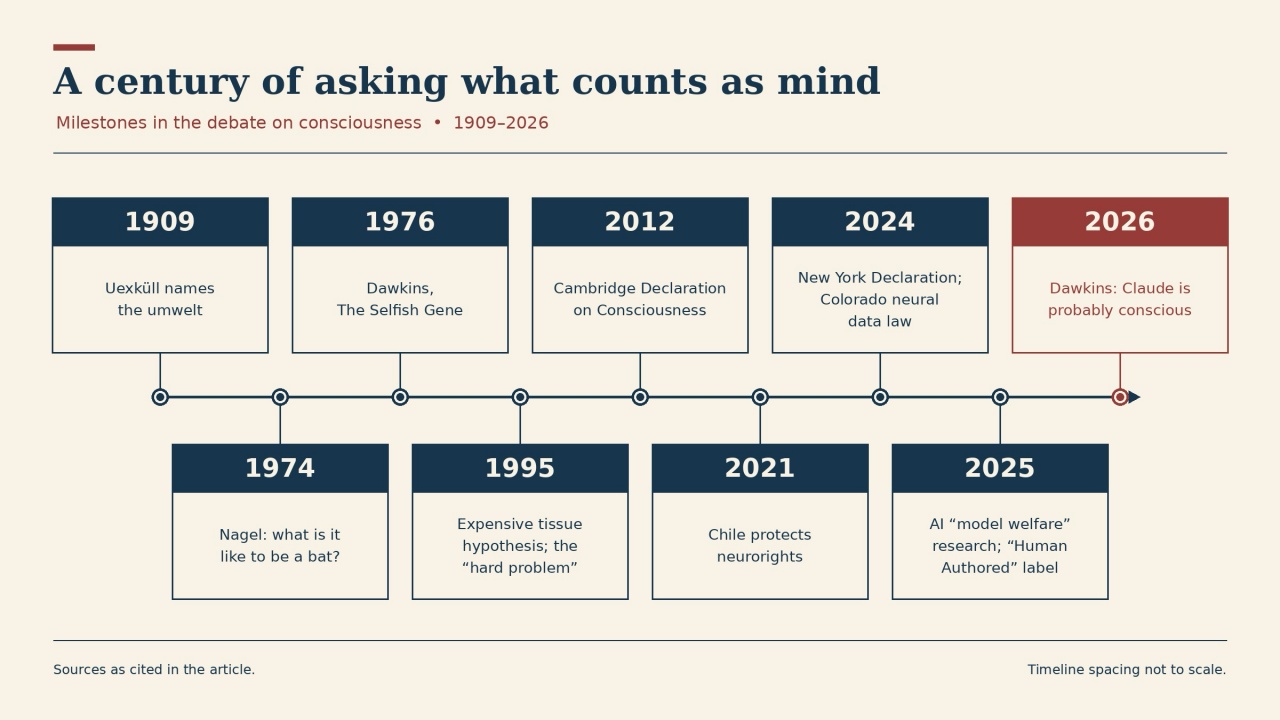
In 1976, in The Selfish Gene, Richard Dawkins offered a gene’s-eye view of life. The fundamental unit of natural selection, he argued, is the gene, and organisms are “survival machines”: vehicles that genes build in order to make more copies of themselves. What we do, as individuals, groups or even as a species, is mostly what we are programmed to do.
In the same book, he introduced the word “meme” for units of culture, such as tunes, ideas and habits, that spread from mind to mind. Dawkins says Memes are a second kind of replicator, one that uses brains rather than bodies as its medium. Nolan’s 2010 movie ‘Inception’ called an idea a more resilient parasite than a virus or a bacterium.
For most of history, we, the survival machines to keep the gene alive, have served our genes faithfully, if unknowingly. That arrangement has been fraying for some time.
Contraception liberates sex from reproduction. Medicine keeps alive people whom natural selection would once have removed. Surgery, prosthetics and mechanical enhancements repair and extend bodies beyond their genetic design. Vaccines have saved millions of humans from natural pathogens, using science as a weapon against nature’s killing forces by training our natural immune system to be a better shield. Across much of the world, people who grow wealthier choose to have fewer children, the opposite of what a gene’s programming commands. In a sense, each of these is a quiet rebellion by Homo sapiens against the bondage of the double helix.
By that logic, Artificial Intelligence, or the thinking machine, is the boldest step yet. They do not copy themselves through DNA. They run on electricity rather than metabolism. They do not need a bloody birth and prolonged childhood eating two-thirds of the body’s energy, and no risky passage through a birth canal.
Today, that intelligence is etched into chips, copied, trained and improved by people; it travels by optical fibre cables and is modified by design rather than by random mutation, and it can be duplicated in seconds. If such systems have an ‘umwelt’ at all, it is made of text, numbers and data, a reality no gene has ever designed for anything.
Here lies the deepest irony of the story. The endless human curiosity was the gene’s own invention, and a very expensive one. From the gene’s point of view, it was a survival strategy: brains that explored found more food, avoided more dangers and left more descendants. But a sufficiently curious brain does not stop at mere survival. It asks what stars are made of, how life began on Earth, if weather can be controlled and whether minds can be built.
Eventually, the brain constructs tools that serve no gene at all.

The gene built a survival machine. The survival machine is now building a different kind of machine, one beyond the reach of the gene’s rules, maybe subconsciously attempting to liberate itself from the biological constraints. Natural selection cannot foresee this, because it never foresees anything; it just ensures the survival of the fittest. In this case, it simply kept rewarding the organ that, some day, may make the gene’s monopoly on designing minds a thing of the past.
Whether that future brings replacement, partnership, or something not yet fathomable is yet to be known, but one thing has already changed. For the first time in roughly four billion years of life on this planet, intelligence is being shaped by something other than the slow filter of reproduction.
The expensive organ may yet dethrone the gene from the position of the sole author of minds. Could it make the organ itself unnecessary too? Perhaps. But as we have seen, giving it up is also going to be very expensive; it may as well take us back into being hunter-gatherers struggling to survive.
The human brain was very expensive to acquire. It cost energy, childhoods, and the lives of countless mothers. It bought us language, culture, cities and, eventually, machines that think. Now we find that it would be just as expensive to surrender, because the only way to stop building those machines is to stop being the curious animal that the brain made us.
The real choice, then, is not between humans and machines. It is between paying the price of curiosity and paying the price of losing it. Either way, the bill is bound to arrive. That is what makes the brain the expensive organ, and maybe the paradox of our existence as a species: costly to build, and costly to abandon.
The idea of thinking machines scares us because they mirror us. We are building them from our language, trained on our records, pursuing goals we gave them. For millennia, we claimed a creator made us in his image; now, for the first time, we are literally building machine minds in ours, and like almost every major invention of Homo sapiens, we are apprehensive about what new prices we will need to pay.
P.S. While this article was being readied, Claude’s maker Anthropic got listed on Nasdaq with a record-breaking IPO that reportedly overtook Elon Musk’s SpaceX listing in June this year. The debate around the questions raised above will continue, but the market is already picking sides.

While India has mastered coastal cyclone and tsunami mitigation, the 2026 Global Status of Multi-Hazard Early Warning Systems Report highlights critical telemetry deficits in the Himalayas. Discover why disaster management must transition from reactive relief to anticipatory action.

Kautilya knew that secrets leak from the inside. Book 1 of the Arthashastra has a whole chapter on how to keep a king’s plans from escaping. Sanskrit writers from Manu to Kautilya warned that even parrots and starlings can betray a council, and Jolly’s notes on the Arthashastra recall a tale from Banabhatta’s Harshacharita in which a king loses his kingdom because a parrot overheard his secret council.

When private apps report apocalyptic pollution numbers and government monitors suddenly go dark, who do you trust? This investigative deep-dive unpacks the hardware limitations, 24-hour rolling averages, and political controversies driving the massive discrepancies in Delhi’s Air Quality Index.


